T. S. R. Boase. Giorgio Vasari: the Man and the Book. A. W. Mellon Lectures, 1971. Bollingen Series XXXV. Princeton: Princeton University Press, 1979. Availability
Among the most intriguing of the Mellon Lectures that I purchased through abebooks.com was T. S. R. Boase’s lecture-cum-tome on perhaps the first art historian, Giorgio Vasari. Boase seemed like an odd choice for both the lecture and the topic. Thomas Sherrer Ross Boase was the second director of the Courtauld Institute in London and a medievalist. Not a household name in the art world, and unlike his successor, Anthony Blunt, certainly not outside it.
Vasari and his work, Le Vite de’ più eccellenti pittori, scultori, ed architettori (Lives of the Most Eminent Painters, Sculptors, and Architects), are well known. I was fascinated at what Boase would say about him. Reading along a sad but frequent fact was reminded me: among Renaissance Italian noble and social-climbing families: brides were selected (by the groom himself) for reasons having nothing to do with love or attraction and often abandoned after marriage.
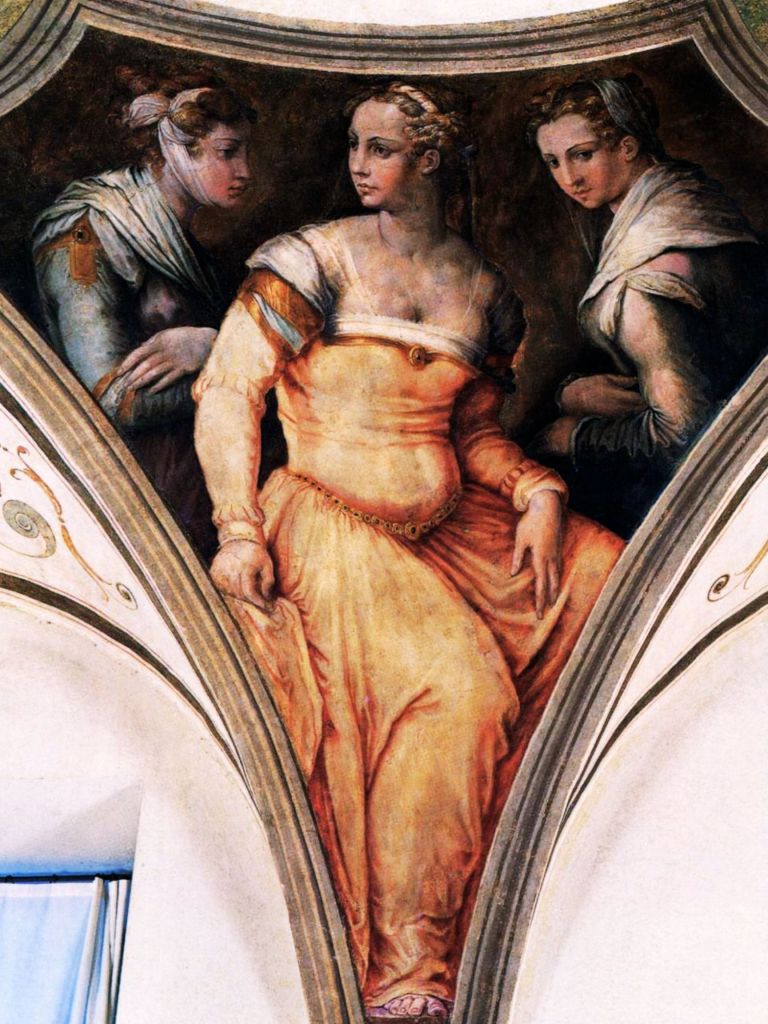
A local Roman cardinal, Gianmaria del Monte, told Vasari to get a wife. Many artists remained unmarried in the Renaissance in order to keep an active work schedule (or, one suspects, play around as much as they liked). There seemed to be a list somewhere (likely only mentally but in Italy, who knows?) of potential brides, rated by class, dowry and location. Giorgio settled on Niccolosa Bacci (always referred to as “Cosina”) from the wealthy Bacci family. She must have had some merits other than her wealth as he was advised not to hold out for 1000 florins for her dowry. He got 800 out of her father. Vasari married her in Arezzo, did some decorations of his family home there with one of his new bride as one of the subjects (above), and then abandoned her for Rome where the good commissions were.
The story’s not usual and I guess that’s what makes it so poignant. She looks fairly hot to me. She’s got a swimmer’s build, broad shoulders, and rather a pretty face. Some men who married for advantage didn’t get even that. Allowing for, A) Mannerist elongation and, B) spousal flattery, she looks to have had a comely figure. And later in life she proved her integrity to him. That makes it eve more of a tragedy. As I say, the story’s not so unusual. They had no children.
Other images of Mrs V: (medal) https://www.nga.gov/collection/art-object-page.44917.html; (double portrait) c. 1565, Badia delle Sante Flora e Lucilla è una chiesa, Arezzo.
 Reading Art History