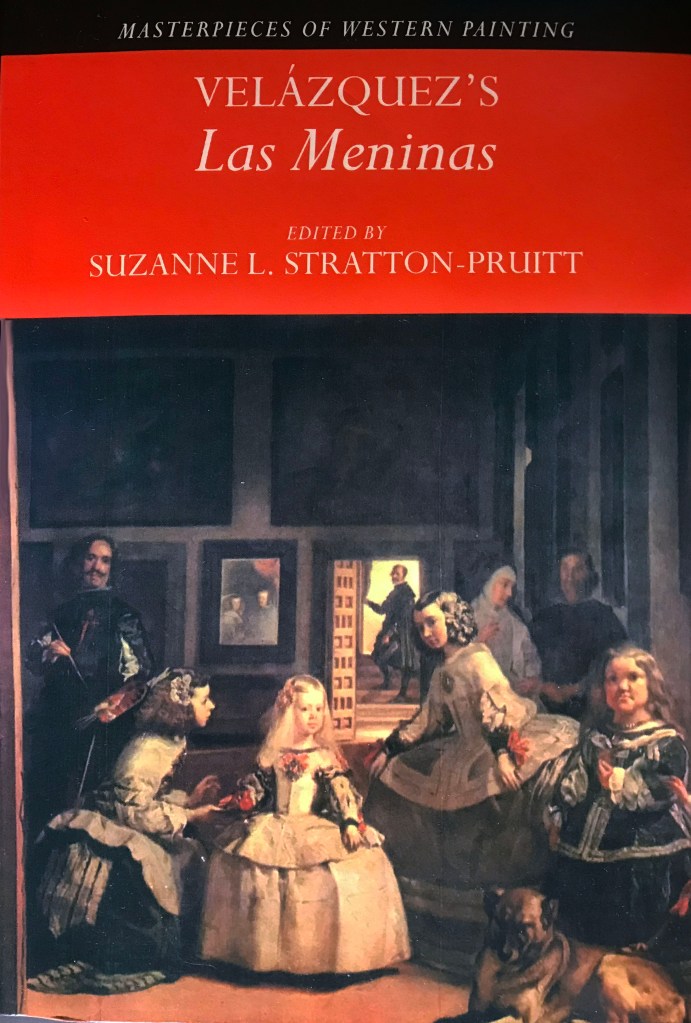
Masterpieces of Western Painting

Periodically publishers issue a series monographs on individual works of art. This is still pretty rare in art publishing. There’s no tenure promotion given on single-artwork writing: what methodological theory can that advance? What new discovery can be wrapped around an entire book on a sole work of art? No, these, when they are written, are only done by scholars safe in their publishing careers.

This is really a shame. Art history started around the concept of the single work of art. Even graduate students in art history, who must, because of things like comprehensive exams, know about all the famous works of art, tend only to cover the highlight factors, the reasons the work is in art books. No graduate student can afford to sit down and read a little book on the aspects of a single painting. Whence the catholic scholar? I don’t know.

Of course, I was one of these graduate students. Through my career I made note of those book series devoted to single works. They are, to a title, still worth reading, still unique.

The Artists in Perspective Series (Prentice-Hall) early 1970s. Although not quite a series on a single work of art, the series, edited by HW Janson (of Janson’s History of Art fame) collected texts throughout art history on eminent artists. These often tended to center around a major work and therefore were nearly as handing as the series, soon to come, below.

Art in Context Series (Penguin/Viking), early 1970s. The undisputed acme of the genre. The brilliant publisher Alan Lane came up with the idea of short books on a sole artwork. To make it work, he appointed Hugh Honor and Jack Fleming, series editors, to commission the top scholars in the field to write these. Looking at the titles and the authors, it reads like a who’s who of 1970s art history. Each only around 100 pages, the scholar generally divided the book into small chapters addressing every approach art history (at the time) could address the work of art. Chapters would include social context, artist biography, commission (if any) and documents, preparatory drawings, reception theory and posthumous analysis. To this day anyone who wants to know how to write an art history paper could do little better than to scan one of these.

Trumbull : the Declaration of Independence
by Jaffe, Irma B. (New York : Viking Press, 1976.)

Poussin: The Holy Family on the steps
by Hibbard, Howard, 1928-1984. ([London] Allen Lane [1974, i.e. 1973])

Delacroix : The Death of Sardanapalus
by Spector, Jack J. (London : Allen Lane, 1974.)

Leonardo: The last supper
by Heydenreich, Ludwig Heinrich, 1903- ([New York, Viking Press, 1974])

Van Eyck: the Ghent altarpiece
by Dhanens, Elisabeth. (New York, Viking Press [1973])


Marcel Duchamp: The Bride Stripped Bare by her Bachelors, Even.
by Golding, John.  (New York: Viking Press, 1973).
Thoughts on Art Books

I have been an academic in art history for thirty-five years and have read just about every book in my narrow subspecialty or assigned as a course reading for a class I was teaching. During CoViD I began pulling off the shelf of my home library (let’s not go into how many books I own) volumes and started peeking at sections. Books I bought to read someday, stuff I thought I should own, titles so damn cheap (in my view) when I encountered them on remainder tables I couldn’t honestly not buy them.

One wall of my friends

And so it goes. Or went.

To my surprise, I found that texts I once considered turgid were elegant. Prose I thought (or had heard) was tortured in fact thoughtful and clear. The names of the great art history writers, their singular subjects, their way of framing a question, spoke to me anew. I found myself making reading lists within reading lists, spending time touching the printed words on the paper page (art history is a tactile pursuit, even when the touching is virtual).

Winston Churchill famously said (a lot of things, actually, but once said), “Whenever a new book comes out one should read an old one.” Not that new research or ways of thinking are always derivative, but newer tomes necessarily build on what’s been published before. It’s a conversation that only the reader of both titles will ever hear. Voices of Silence.

Of course this kind of reading is treacherous. We always blame the author or the book for our interpretive wanderings. “Galeotto fu il libro e chi lo scrisse,” Francesca complains to Dante. Dipping into too many books and passages too briefly to appreciate the whole work leaves one with nothing but sherds. Much of that could be said for university education today as well.

My comments here will necessarily be ephemeral. It’s the little things about reading in art history that strike me as worthwhile. There’s plenty of reviews and opinions on the books I choose to read here. It’s the odd thoughts well-researched books provide that interests me, that I write about here.

So, gentle reader, accompany me while I read or re-read kunstgeschichtliche bücher. Accompany me while I discover a well-established book–much the way early white explorers discovered new lands known for centuries by their inhabitants. Books well known and those fading in the noise of the internet and the soundbite. My very personal reactions to books. To everyone who still has an attention span and the love of acid-free paper pulp, get yourself a cup of coffee and tell me what you thought of the book I just encountered. Or what you encountered.

Giorgio Vasari: the Man and his Woman

This image has an empty alt attribute; its file name is untitled-design.jpg
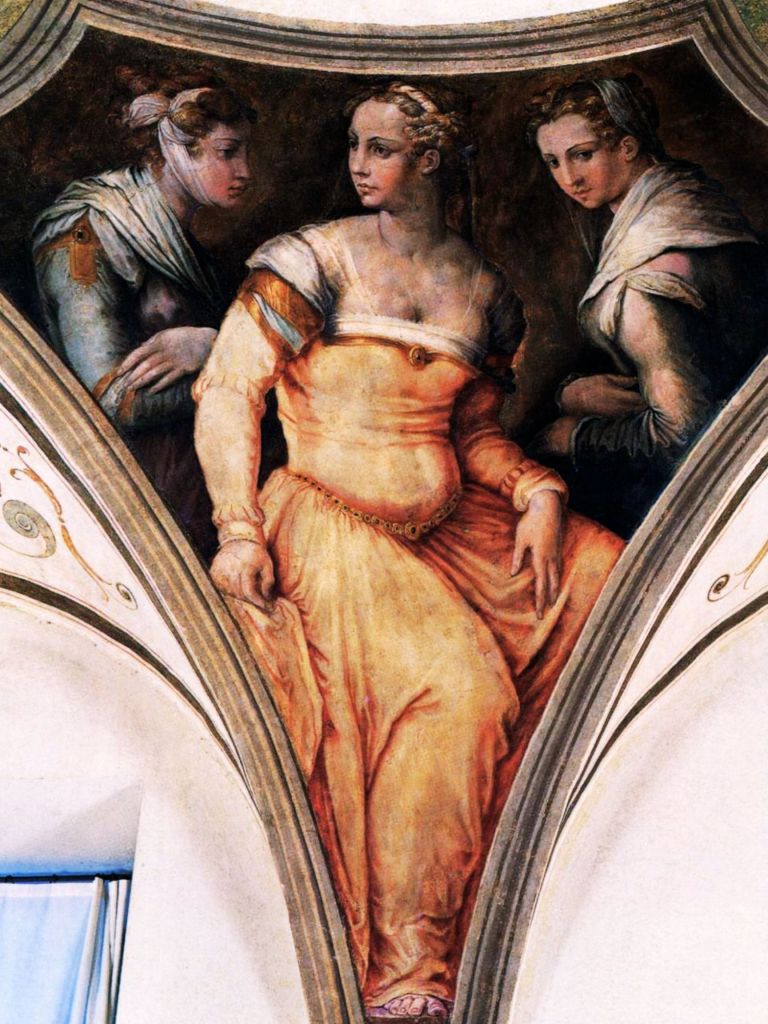
Niccolosa “Cosina” Bacci (Mrs Vasari) as a muse, painted shortly after her marriage to Giorgio in 1550 in a fresco in their home in Arezzo.

T. S. R. Boase. Giorgio Vasari: the Man and the Book. A. W. Mellon Lectures, 1971. Bollingen Series XXXV. Princeton: Princeton University Press, 1979. Availability

Among the most intriguing of the Mellon Lectures that I purchased through abebooks.com was T. S. R. Boase’s lecture-cum-tome on perhaps the first art historian, Giorgio Vasari.  Boase seemed like an odd choice for both the lecture and the topic. Thomas Sherrer Ross Boase was the second director of the Courtauld Institute in London and a medievalist.  Not a household name in the art world, and unlike his successor, Anthony Blunt, certainly not outside it.

Vasari and his work, Le Vite de’ più eccellenti pittori, scultori, ed architettori (Lives of the Most Eminent Painters, Sculptors, and Architects), are well known.  I was fascinated at what Boase would say about him.  Reading along a sad but frequent fact was reminded me: among Renaissance Italian noble and social-climbing families:  brides were selected (by the groom himself) for reasons having nothing to do with love or attraction and often abandoned after marriage.

A local Roman cardinal, Gianmaria del Monte, told Vasari to get a wife. Many artists remained unmarried in the Renaissance in order to keep an active work schedule (or, one suspects, play around as much as they liked). There seemed to be a list somewhere (likely only mentally but in Italy, who knows?) of potential brides, rated by class, dowry and location. Giorgio settled on Niccolosa Bacci (always referred to as “Cosina”) from the wealthy Bacci family. She must have had some merits other than her wealth as he was advised not to hold out for 1000 florins for her dowry. He got 800 out of her father. Vasari married her in Arezzo, did some decorations of his family home there with one of his new bride as one of the subjects (above), and then abandoned her for Rome where the good commissions were.

The story’s not usual and I guess that’s what makes it so poignant. She looks fairly hot to me. She’s got a swimmer’s build, broad shoulders, and rather a pretty face. Some men who married for advantage didn’t get even that. Allowing for, A) Mannerist elongation and, B) spousal flattery, she looks to have had a comely figure. And later in life she proved her integrity to him. That makes it eve more of a tragedy. As I say, the story’s not so unusual. They had no children.

Other images of Mrs V: (medal) https://www.nga.gov/collection/art-object-page.44917.html; (double portrait) c. 1565, Badia delle Sante Flora e Lucilla è una chiesa, Arezzo.